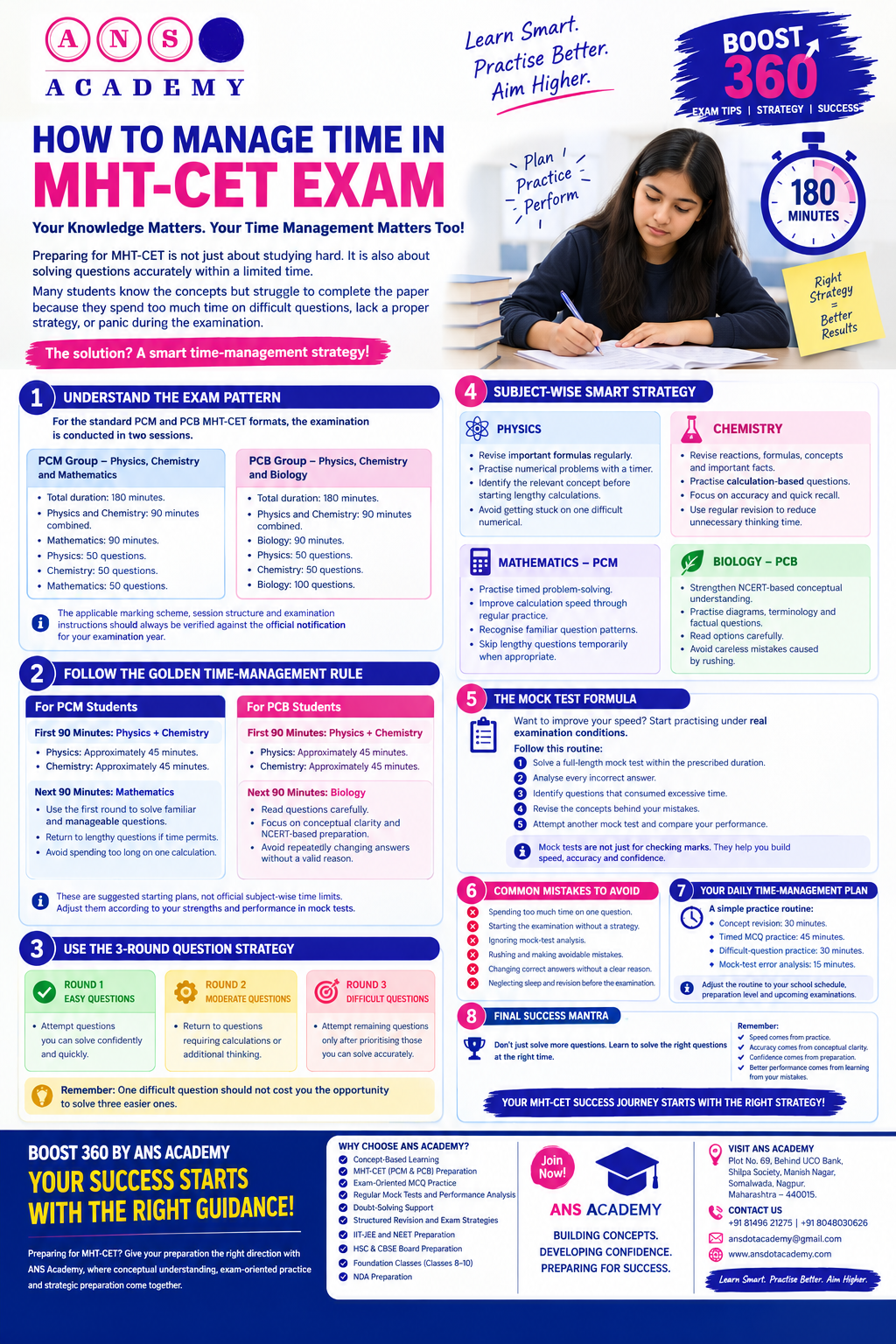
HOW TO MANAGE TIME IN MHT-CET EXAM
Your Knowledge Matters. Your Time Management Matters Too!
Preparing for MHT-CET is not just about studying hard. It is also about solving questions accurately within a limited time.
Many students know the concepts but struggle to complete the paper because they spend too much time on difficult questions, lack a proper strategy, or panic during the examination.
The solution? A smart time-management strategy!
1. UNDERSTAND THE EXAM PATTERN
For the standard PCM and PCB MHT-CET formats, the examination is conducted in two sessions.
PCM Group – Physics, Chemistry and Mathematics
* Total duration: 180 minutes.
* Physics and Chemistry: 90 minutes combined.
* Mathematics: 90 minutes.
* Physics: 50 questions.
* Chemistry: 50 questions.
* Mathematics: 50 questions.
PCB Group – Physics, Chemistry and Biology
* Total duration: 180 minutes.
* Physics and Chemistry: 90 minutes combined.
* Biology: 90 minutes.
* Physics: 50 questions.
* Chemistry: 50 questions.
* Biology: 100 questions.
The applicable marking scheme, session structure and examination instructions should always be verified against the official notification for your examination year.
2. FOLLOW THE GOLDEN TIME-MANAGEMENT RULE
For PCM Students
First 90 Minutes: Physics + Chemistry
* Physics: Approximately 45 minutes.
* Chemistry: Approximately 45 minutes.
Next 90 Minutes: Mathematics
* Use the first round to solve familiar and manageable questions.
* Return to lengthy questions if time permits.
* Avoid spending too long on one calculation.
For PCB Students
First 90 Minutes: Physics + Chemistry
* Physics: Approximately 45 minutes.
* Chemistry: Approximately 45 minutes.
Next 90 Minutes: Biology
* Read questions carefully.
* Focus on conceptual clarity and NCERT-based preparation.
* Avoid repeatedly changing answers without a valid reason.
These are suggested starting plans, not official subject-wise time limits. Adjust them according to your strengths and performance in mock tests.
3. USE THE 3-ROUND QUESTION STRATEGY
ROUND 1: EASY QUESTIONS
Attempt questions you can solve confidently and quickly.
ROUND 2: MODERATE QUESTIONS
Return to questions requiring calculations or additional thinking.
ROUND 3: DIFFICULT QUESTIONS
Attempt remaining questions only after prioritising those you can solve accurately.
Remember: One difficult question should not cost you the opportunity to solve three easier ones.
4. SUBJECT-WISE SMART STRATEGY
PHYSICS
* Revise important formulas regularly.
* Practise numerical problems with a timer.
* Identify the relevant concept before starting lengthy calculations.
* Avoid getting stuck on one difficult numerical.
CHEMISTRY
* Revise reactions, formulas, concepts and important facts.
* Practise calculation-based questions.
* Focus on accuracy and quick recall.
* Use regular revision to reduce unnecessary thinking time.
MATHEMATICS – PCM
* Practise timed problem-solving.
* Improve calculation speed through regular practice.
* Recognise familiar question patterns.
* Skip lengthy questions temporarily when appropriate.
BIOLOGY – PCB
* Strengthen NCERT-based conceptual understanding.
* Practise diagrams, terminology and factual questions.
* Read options carefully.
* Avoid careless mistakes caused by rushing.
5. THE MOCK TEST FORMULA
Want to improve your speed? Start practising under real examination conditions.
Follow this routine:
1. Solve a full-length mock test within the prescribed duration.
2. Analyse every incorrect answer.
3. Identify questions that consumed excessive time.
4. Revise the concepts behind your mistakes.
5. Attempt another mock test and compare your performance.
Mock tests are not just for checking marks. They help you build speed, accuracy and confidence.
6. COMMON MISTAKES TO AVOID
❌ Spending too much time on one question.
❌ Starting the examination without a strategy.
❌ Ignoring mock-test analysis.
❌ Rushing and making avoidable mistakes.
❌ Changing correct answers without a clear reason.
❌ Neglecting sleep and revision before the examination.
7. YOUR DAILY TIME-MANAGEMENT PLAN
A simple practice routine:
* Concept revision: 30 minutes.
* Timed MCQ practice: 45 minutes.
* Difficult-question practice: 30 minutes.
* Mock-test error analysis: 15 minutes.
Adjust the routine to your school schedule, preparation level and upcoming examinations.
8. FINAL SUCCESS MANTRA
Don’t just solve more questions. Learn to solve the right questions at the right time.
Remember:
* Speed comes from practice.
* Accuracy comes from conceptual clarity.
* Confidence comes from preparation.
* Better performance comes from learning from your mistakes.
YOUR MHT-CET SUCCESS JOURNEY STARTS WITH THE RIGHT STRATEGY!
YOUR SUCCESS STARTS WITH THE RIGHT GUIDANCE!
Preparing for MHT-CET? Give your preparation the right direction with ANS Academy, where conceptual understanding, exam-oriented practice and strategic preparation come together